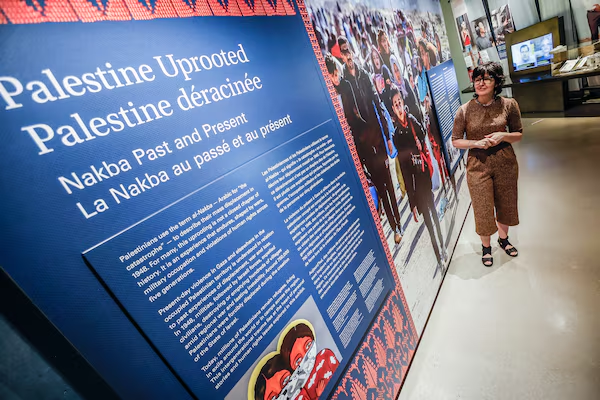
Canadian Zionists initially intended to focus the Canadian Museum for Human Rights on the Holocaust, antisemitism and the need for a Jewish State. Ironically, a tiny addition to the Museum referring to the Nakba, has turned that upside down by provoking a long overdue public discussion about the violence involved in the creation of Israel in 1948. Read more.
The Canadian Museum for Human Rights (CMHR) was the brainchild of Israel Asper, a wealthy Winnipeg businessman and lifelong Zionist. Asper and his daughter Gail Asper spearheaded a massive public and private fundraising campaign. He said was inspired by the US Holocaust Museum in Washington DC.
Asper donated 10% of the total cost of the museum. The Aspers turned to Federal, Provincial and Municipal sources for funding who insisted that it had to also recognize other stories of displacement and discrimination including Indigenous Canadians and Ukrainian Canadians.
The museum foundation’s board backed down from its original plan. Little by little, the focus on the Holocaust, antisemitism and the State of Israel was downsized. Where it had proposed a huge Holocaust gallery with some “side exhibits”, the board reluctantly agreed to multiple galleries of equal weight.
Enter the Palestinians
Palestinian Canadians also began raising the issue of the inclusion of information on the Nakba. “Our efforts to support and advocate for its development began even before the museum opened its doors”, commented Ramsey Zeid, President of the Canadian Palestinian Association of Manitoba. Rana Abdullah, a Palestinian Canadian community activist, submitted stories she had collected from Nakba survivors living in Canada. Her pitch was: “Palestinians have a critical human rights story that should be fully presented in the museum.”
Their submissions were rebuffed. When the Museum was officially opened in September 2014. There was no mention of either the Nakba or of Palestinians.
Ten years later – a change of heart
That changed in 2024. when the museum announced it would collaborate with Palestinian Canadians to develop gallery content about “the human rights violations Palestinians experience every day”.
Two factors appear to have pushed the CMHR to change and approve a section on the Nakba.
Stubborn Palestinian-Canadian advocacy continued to argue that the museum couldn’t be taken seriously without the Palestinian story. The Canadian Palestinian Association of Manitoba and others drew support from accross Canada. And three years of genocidal Israeli attacks on Gaza had turned Canadian public opinion significantly towards the Palestinian cause and against Zionism.
Zionist “own goal”
(Own goal – definition. An accidental score by a player into their own team’s nets in sports like soccer or hockey
What was initially created as a propaganda vehicle for Zionism and the creation of the Jewish State of Israel has now turned into its opposite. The personal stories in the Nakba exhibit at the Museum about the violence suffered by Palestinians at the hands of Zionist militias starting in 1947/8 are an indictment of the Zionist narrative of “a land with no people for a people with no land”.
The CMHR now includes a small exhibit on the Nakba entitled “Palestine uprooted: Nakba past and present”. It takes up approximately 5% of the total exhibition space in the museum. The Palestine exhibit was described by one early visitor as “pretty small… only 12 metres big. Its 3 displays and less than 600 words of text”. Although small, the exhibit has shone a light on the violence associated with the creation of Israel itself.
The Zionist lobby has made their situation worse by mounting a campaign to discredit the exhibit. David Asper said the museum was becoming “the tool, or dupe, of only one side of the story”. (This seems a strange criticism given the fact that the original idea was for a museum like the US Holocaust Museum exclusively focussed on the Jewish experience of the Holocaust).
An Israeli group, Shurat Hadin has even threatened legal action, demanding an “independent legal and scholarly review”. Other Zionist groups have launched petitions to force the Canadian government to suspend the exhibit.
All of this has focussed even more attention on the Nakba, and drawn scorn from many observers, including some prominent liberal Jews. “The backlash against the Nakba exhibit is preposterous” wrote Globe and Mail columnist Marsha Lederman, a well known liberal Zionist. “The job of a human rights museum is to tell the truth., argues George Strombopoulous.
OFIP offers advice to the Zionist lobby. “When you are in a hole, stop digging”.
Canada Talks Israel Palestine is the biweekly newsletter of the Ottawa Forum on Israel/Palestine (OFIP). It aims to promote a serious discussion ababout the Israel/Palestine issue from a Canadian perspective. Readers are invited to make comment. To get on our regular mailing list, or for more information write: ofip.chair@gmail.com


Thanks, Peter. You are absolute correct. A long overdue public discussion about the violent creation of Israel is long overdue. Canada has an opportunity to lead the world. What if Jewish Zionists, Christian Zionists, Palestinians and Canadians like me with no particular link to Israel / Palestine were able to have a national discussion or something like the Truth and Reconciliation Commission. We all come from a different place, we are all Canadians, and believe it or not we are all human beings with similar goals and aspirations. If the Canadian government stood behind this, wouldn’t it send an incredible message to the world. That, my friend, would be something that all Canadians would be proud to have Canada remembered in history.
Love the conclusion.
In another successful own goal, Irwin Cotler, Mark Berlin, and Alan Kessel published an op-ed in the Globe and Mail on June 24. The authors argued that the Canadian Museum for Human Rights should have discussed Jewish migration from Arab countries to Israel in their exhibit on the Nakba. Berlin, who had resigned from the Museum’s board, had said “There’s the Palestinian Nakba and the Jewish Nakba”
Any attempt to liken the Palestinian Nakba to the exodus of Jews from other parts of the Middle East is a distortion of history. A comparison only make the real Nakba look worse; there are too many contrasts.
The Palestinians who were denied the right to continue living as equals in their ancestral lands left unwillingly, often without any place to go. In contrast, most of the Jews who left Arab countries did so believing that they were moving to a place that would be better for them.
Many Palestinians had difficulty finding countries that would accept them, and some are still living as foreigners in refugee camps. Conversely, all of the Jews were welcomed and helped to settle when they got to Israel.
Most of the Middle Eastern Jews who moved, eventually had the right of return to their native countries. Israel has always denied any such right to Palestinians.
I know from personal experience that Israel continues to try to convince Jews living elsewhere to move there. At the same time, they are “encouraging” Palestinians to leave their homeland by destroying homes and infrastructure. The Palestinian Nakba continues to this day.
Wikipedia has an excellent and balanced discussion of the Jewish exodus from the Muslim world. Readers who want to know more (including the authors of the Cotler/Berlin/Kessel column) should read it. (https://en.wikipedia.org/wiki/Jewish_exodus_from_the_Muslim_world)
By stimulating discussion of this sad part of human history, the Canadian Museum for Human Rights is fulfilling its mandate.
Thanks, Peter. Ditto to Marianna’s comment.
Ida
I’m currently driving across Canada and stopped to see the museum 2 days ago. It was my first visit, and I had not seen this post. The mood it sets up is impressive and moving. As I went through the exhibits in order I noticed the absence of the Palestinian Nakba and the Gaza genocide. Then I came to the end and there it was, the small exhibit you referred to Peter.
The irony was inescapable. First the Jews of Europe suffer the Holocaust, and now Israel is an apartheid Jewish country perpetrating a similar ethnic cleansing.
Well said, Peter. Another small win.
Regards,
David
>
I wonder if the museum includes, as part of its focus on the “Jewish experience of the Holocaust,” the role of Jewish Councils — the “Judenrats” — in the Final Solution. In Eichmann in Jerusalem (1963), Hannah Arendt’s account of the Adolph Eichmann trial, Arendt wrote that Eichmann considered the cooperation of the Councils to be the “cornerstone” of the Nazi policy of eradicating Europe’s Jews. The Councils “were informed by Eichmann or his friends how many Jews were needed to fill each train, and they made out the list of deportees.” They did it with dedication and Teutonic efficiency. “Mere compliance would never have been enough” to sustain a Europe-wide effort to annihilate 11 million people. “To a Jew this role of the Jewish leaders in the destruction of their own people is undoubtedly the darkest chapter of the whole dark story.” Is this included? It’s part of the “Jewish experience,” no?
I am sure it does not include any reference to that. In situations of oppression, it normally happens that some people want to resist and some choose to collaborate. If you saw the film “Palestine 36”, which came out recently, you will recognize rich Muslim landlords who prefer to collaborate with the Zionists rather than joino the resistance. I’m sure it happened with Jews trying to stay alive under the nazis.
Jews in Europe were divided, rich vs. poor, Sephardic vs. Ashkenazi, assimilated into German society or raised in an Eastern European Stetl. My Sephardic maternal grandmother was said to look down on Ashkenazi families. At the start of the Holocaust she refused to leave her home, writing that “they” only wanted to get rid of the poor Jews from the East. Later, she wanted to leave but the Germans had made it more difficult and she could not. Eventually she was “deported eastwards” and killed in a camp. My Ashkenazi paternal grandparents fled as soon as they could and survived.
People of all kinds have stupid, ignorant, prejudices. No ethnic group is spared such people. Sometimes they betray or kill others; sometimes it leads to their own deaths. Either way, hate kills.
I see you have not posted my comment about the role of Jewish leadership in the Final Solution, as reported in Hannah Arendt’s Eichmann in Jerusalem, first published in installments in The New Yorker in 1961. She was commissioned by William Shawn, who later put the magazine in peril with its reports onViet Nam. Arendt of course made her reputation with Origins of Totalitarianism in 1951.
The Eichmann book was not well received by Jew nation, even with the impeccable credentials of Arendt and Shawn. This reminds me of the reaction of Jews to the Goldstone Report, about Israel’s Operation Cast Lead in 2008-09. Richard Goldstone was a respected South African jurist whom people, including Jews, trusted. He was endorsed by no less than Nelson Mandela. But things changed when Goldstone found Israel had committed war crimes, leading to 1400-plus deaths, a shocking number then but given what Israel has done since, almost quaint. Goldstone was vilified as a traitor to his people. He was barred from his grandson’s bar mitzvah in Sandton, outside Johannesburg. https://forward.com/opinion/127280/goldstone-barred-from-grandsons-bar-mitzvah/
The “Holocaust,” so-called, was a complex event, in which Jewish leadership in Europe and Zionist leadership in the British Mandate in Palestine participated. Ben-Gurion wanted European Jews to emigrate to Palestine. The Nazis wanted them gone, by whatever means. In that way they made common cause. That and more came out in the Eichmann trial, during its 121 sessions from April to December, 1961. Trials, like wars, are prone to unexpected consequences. Ben-Gurion would not have intended the Eichmann trial to have produced evidence of Jewish complicity in the annihilation of European Jewry, nor would Israel have expected Goldstone to report Israeli war crimes. Both things, however, happened. Query why people shouldn’t know that.
sorry. been away.