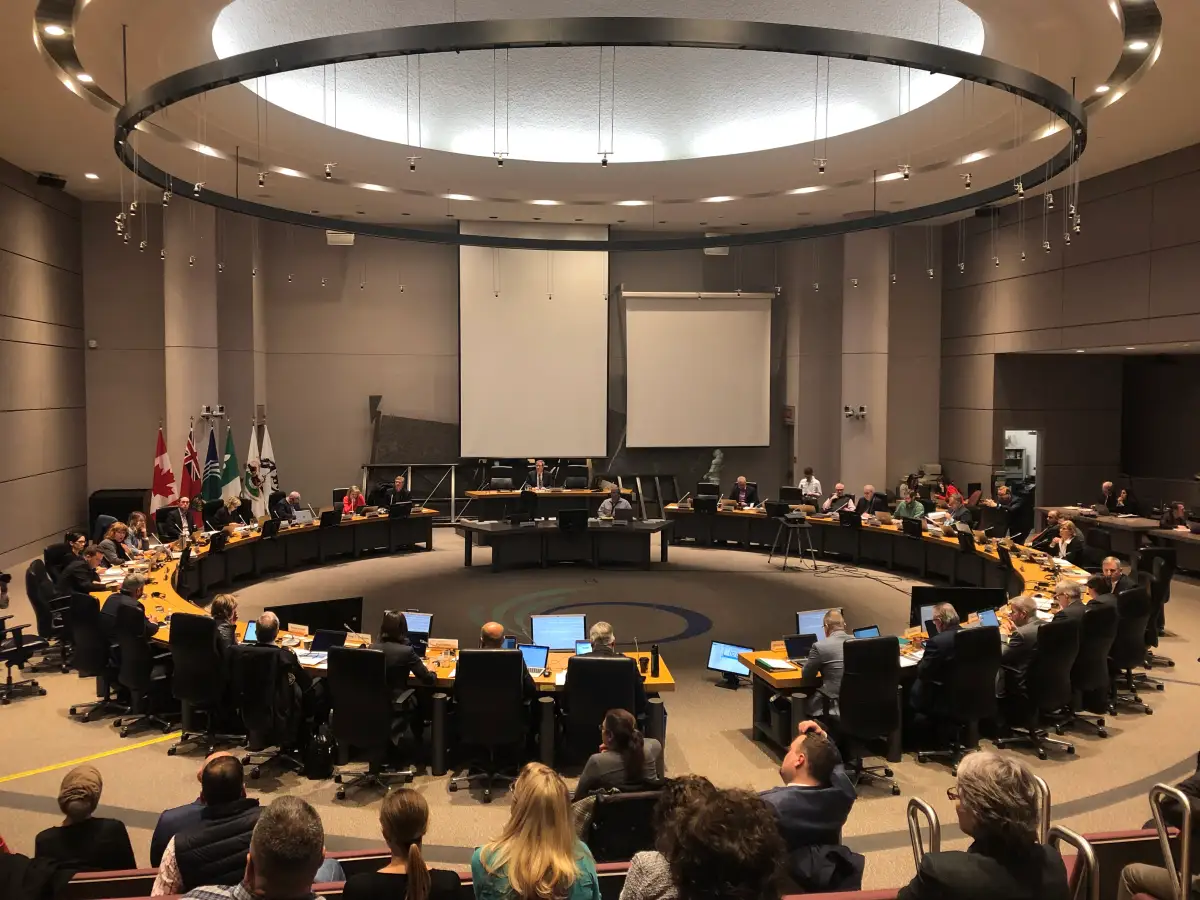
Ottawa City council took a principled and courageous stand against injustice in 1988. Would it stand by that today? And where might it apply?
On September 21, 1988, Ottawa City Council passed the following motion put forward by the Policy, Priorities and Budgeting Committee, chaired by Mayor Jim Durrell.
“That the City of Ottawa condemn apartheid in South Africa and proclaim itself an anti-apartheid city”.
- In favour 16
- opposed 1 (Councillor Jackie Holtzman)
- CARRIED
Several other motions were also adopted including naming city infrastructure after Nelson Mandela, encouraging other cities to follow suit, as well as ensuring that the city boycott products from South Africa.
At the time it was a courageous and principled move for the city to take. Nelson Mandela was still in prison on Robben Island and still labeled a terrorist by Canada’s allies, the US and the UK. In fact, Mandela remained on the US terrorism watch list until 2008, when Congress passed a law to remove him and the ANC from the “terrorist” list.
Ottawa researcher Don Lalonde discovered the resolution buried in Ottawa city archives, and asked the current Mayor and councillors a simple question: Does the city of Ottawa stand by its resolution proclaiming it “an anti-apartheid” city?
Today, South Africa is no longer an apartheid state. But many humanitarian organizations have labeled Israel an apartheid state, including:
- Amnesty International: report calling Israel’s treatment of Palestinians “apartheid” and a crime against humanity.
- Human Rights Watch: described Israel’s actions as apartheid, citing the systematic oppression of Palestinians.
- B’Tselem: This Israeli human rights organization has used the term “apartheid” to describe Israel’s policies towards Palestinians.
- UN Human Rights Experts: A UN special rapporteur has stated that Israel’s 55-year occupation of Palestinian Territory amounts to apartheid.
- The International Court of Justice has also found Israel responsible for apartheid-like policies.
- etc.
So if the City of Ottawa still calls itself an “anti-apartheid city” would it be appropriate for Ottawa to join the “apartheid free community movement” slowly spreading across North America? The city of Brampton Ontario is the most recent to debate this measure.
OFIP spoke to Don Lalonde about how he found out and what he wants the city to do.
Canada Talks Israel Palestine is the weekly newsletter of the Ottawa Forum on Israel/Palestine (OFIP). It aims to promote a serious discussion about Canada’s response to the Israel/Palestine issue. Readers are invited to make comment. To get on our regular mailing list or for more information write: ofip.chair@gmail.com
 Canada Talks Israel/Palestine
One must be careful about assuming that two things are the same just because some people use the same word to describe both.
“Apartheid” is a Dutch/Afrikaans term that I would translate as “separation” or “separateness”. It was chosen as a slogan by an Afrikaner political party to describe a system in which people of different “races” would live separately. Although it worked to benefit whites and disadvantaged others, that was not the principle; the principle was that races would live in separate worlds. As far as I could see, the inventors did not plan to seize all of South Africa for themselves; they saw themselves as a tiny white minority surrounded by others and did not believe that they were the only race entitled to live in South Africa. Significantly, the label “apartheid” was used by both opponents and supporters of the system.
What I have witnessed in Israel is quite different. Many Israelis really believe that all of the land that they now control (and more) is rightfully theirs. They would like to expel non-Jews or get rid of them in any way they can. Separation is not their goal – they want to expand and take all the land that they believe was given to them. Beyond wanting to protect and benefit themselves, there is a deliberate policy of depriving others of rights and benefits. Some opponents have decided to use the term “apartheid” to describe the system; the proponents do not accept that label.
Having made that distinction, I agree that the Ottawa City Council, and every other governing body, should condemn what Israel is doing to non-Jews that live in their neighbourhood. I think that they should have done this long ago but better late than never. They should not do it because of an old resolution condemning the original apartheid or because other groups have done it. They should do it because the Israeli policy is evil and should be fought in any way we can.
I believe that those who apply the word “apartheid” to the Israeli system are being too kind and too gentle. What the South Africans were doing was wrong and we should all rejoice that it was defeated; however, what the Israelis are doing is worse, far worse. It deserves a stronger term.
What an appropriate step to take!