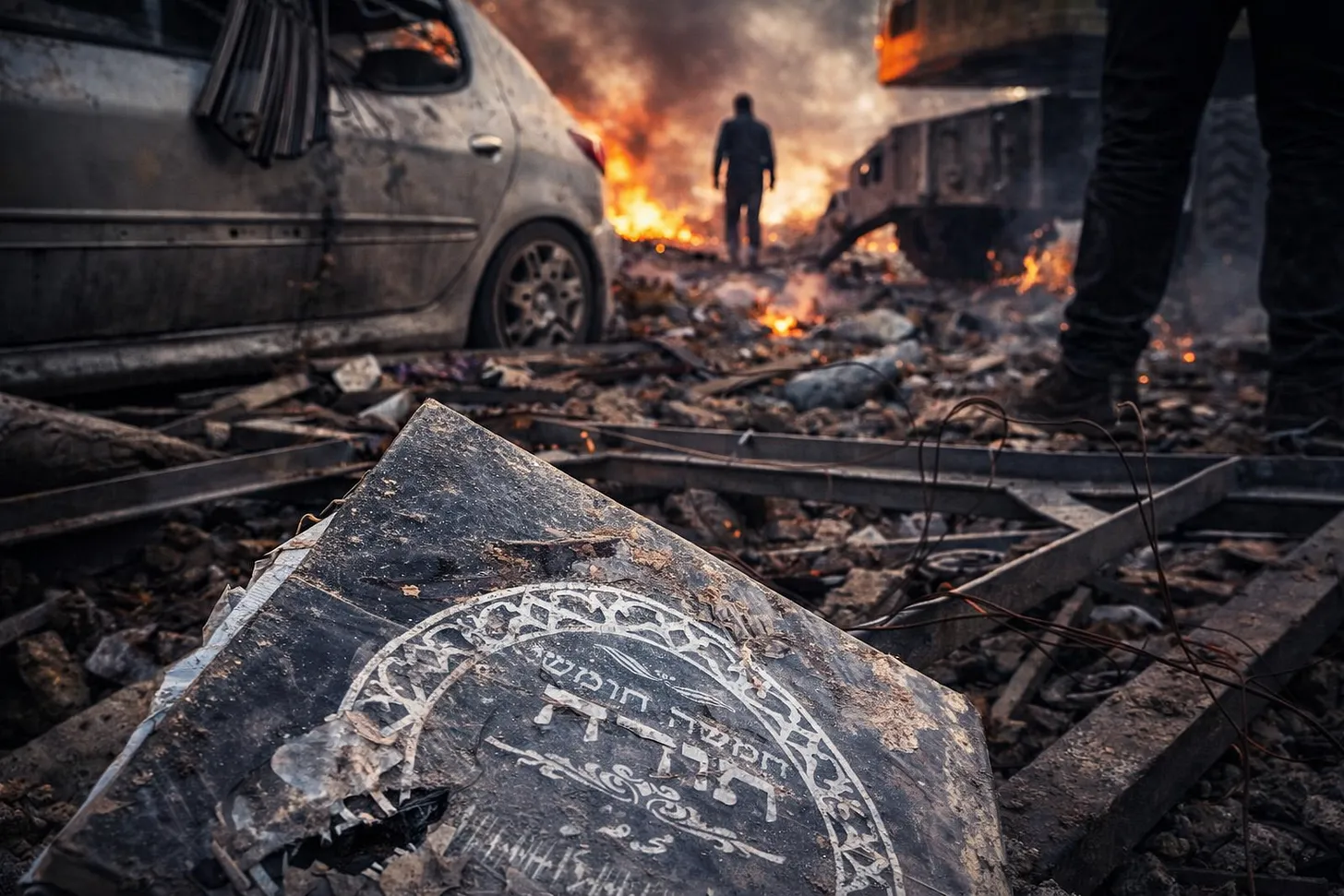
On April 7, the Israeli air force bombed a large Jewish synagogue in Teheran, home to one of the oldest Jewish communities in the world. Few people can imagine that Israel would act against Jews—in other words, commit antisemitic acts. But it has done so before. A leading Jewish Canadian scholar explains what most Canadians would find hard to believe. Read more.

“The bombing of the Tehran synagogue was not the first antisemitic act committed by Israel”, argues Dr. Yakov Rabkin in an essay published in “Neutrality Studies” a few days after the bombing. “In January 1951, Israeli agents threw a grenade into a synagogue in Baghdad. This was one of a series of acts designed to encourage Jews to leave Iraq and relocate to Israel,” he argues.
In the 1950’s, Israeli agents also organized similar provocations against Jews in Egypt and Morocco. The new Zionist state, which had expelled hundreds of thousands of Palestinian Arabs, needed Jews to fill empty houses and villages in Palestine (now called “Israel”).
British Jewish scholar Avi Shlaim, who was five years old when he left Iraq, recalls his mother telling him, “Zionism is an Ashkenazi thing.” “The ethnic cleansing of Palestine created empty spaces, and these spaces had to be filled by Jews from anywhere they could be found, including Jews from the Middle East, even those who had no desire whatsoever to relocate to Israel“, Shlaim recounts in his book Three Worlds: Memoir of an Arab Jew.
The Jews in Iran don’t count for Israel because they are not Zionists according to Dr. Rabkin. “Jews in Muslim lands, who lived in far greater peace than their counterparts in Europe, played no part in the emergence of the Zionist movement at the turn of the 20th century. To force them to relocate to Israel, antisemitic acts were deemed a convenient tool—staged for political ends.
For Israel, Zionism trumps Judaism
The Israeli bombing of the Rafi-Nia synagogue in Teheran took place in in the middle of the Jewish holiday of Passover. The attack underlined Israel’s willingness to treat Jewish life as disposable in the service of its Zionist project. There is no evidence to indicate that Israel deliberately “targeted” the synagogue. The Israeli military claims that the synagogue was “hit by collateral damage”. That was the same claim made about the attack on the girls school several weeks earlier. Whether intentional or not, it appears that israel is not particularly concerned about innocent civilians whether they are primary school kids or Jewish congregants.
“The Jewish community of Iran – now numbering around 15,000 – refused to join the Zionist project of colonizing Palestine. Despite sustained efforts by Israel to encourage their emigration (their numbers once exceeded 100,000), this remaining community has insisted that Iran — not Israel — is their home“,” writes Jared Sachs in Mondoweiss.
“Predictably, Israel is the most dangerous place for Jews. Since the late 19th century, critics of Zionism warned that a Zionist state would become a death trap, endangering both colonizers and colonized alike. For these critics—especially those outside Israel—the Zionist experiment is a tragic mistake. They argue that the sooner it ends, without harm to its inhabitants, the better for humanity as a whole”, concludes Dr. Rabkin.
Ironically, until the joint Israeli/American attack on Iran, Iran’s Jews were safer than those in Israel. Israel’s actions have put those Jews in danger, too.
Canada Talks Israel Palestine is the biweekly newsletter of the Ottawa Forum on Israel/Palestine (OFIP). It aims to promote a serious discussion ababout the Israel/Palestine issue from a Canadian perspective. Readers are invited to make comment. To get on our regular mailing list, or for more information write: ofip.chair@gmail.com


