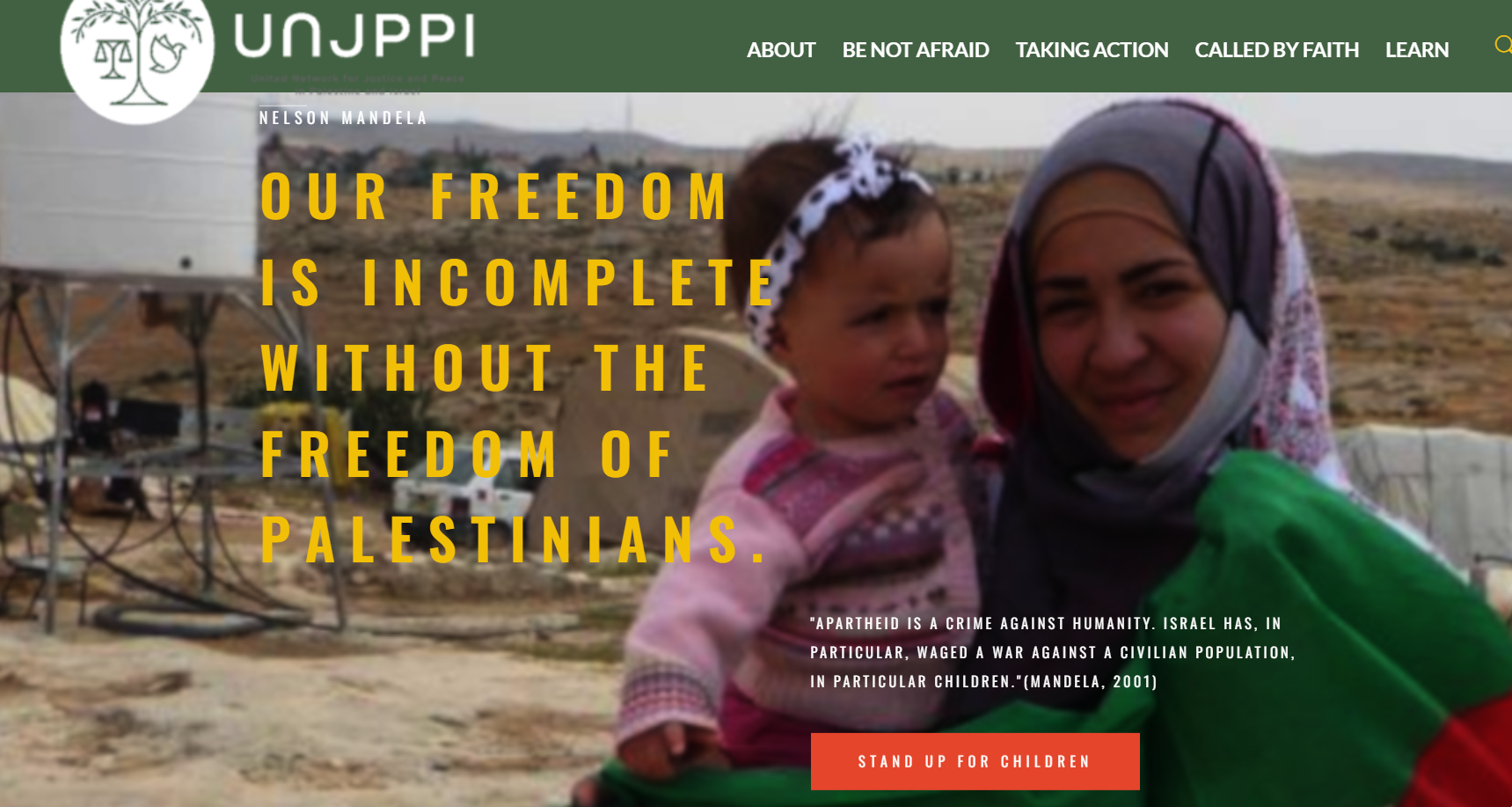
The Canadian human rights activist group UNJPPI – formerly known as the United Network for Justice and Peace in Palestine and Israel, is now called the United Network for Justice and Peace in Palestine/Israel. Why the slight change? We met with incoming co-chair Diane Blanchard to learn about UNJPPI’s plans for 2026, and about why they have slightly changed the name. Watch our interview below.
UNJPPI (United Network for Justice and Peace in Palestine/Israel) was established in 2012 as a grassroots network of United Church members and friends.
Many UNJPPI members had spent time in the West Bank, Jerusalem and Gaza as part of the World Council of Churches initiative called the Ecumenical Accompaniment program in Palestine and Israel (EAPPI). That program brings Christians from around the world to accompany Palestinian farmers and school kids to protect them from the attacks of settlers.
I had a short conversation with incoming UNJPPI co-chair Rev. Diane Blanchard about the origins of UNJPPI, its relationship to the United Church of Canada, its plans for 2026 and the rationale for slightly changing the name of the organization.
Reverend Blanchard who shares chairing duties with George Barrette, outlined some of the interesting projects UNJPPI has planned for 2026 including:
- A free online course for beginners on the history and current reality in Palestine/Israel
- trying to start a few “apartheid free communities” across the country
- Training facilitators for a “Palestinian land exercise” loosely modelled on the very successful “blanket” exercise which has been widely used in Canada to broaden understanding of the effects of settler colonialism in Canada
- a renewed call to speak “truth” even if words like “apartheid”, “genocide” and “ethnic cleansing” make some other people uncomfortable.
UNJPPI also sends out a free monthly newsletter to over 1000 subscribers with information on projects and activities.
What’s in a name?
I also quizzed Diane about the reasoning behind UNJPPI’s name change – replacing the phrase “Palestine AND Israel” with the simpler “Palestine/Israel”. When the idea of a “two state solution” still had currency, Israel AND Palestine was a common way of phrasing the conflict. It is still the official United Church phrasing, for example. But as the the two state idea has receeded as a possible solution, that has become less common. Organizations use different formulations to refer to the region, reflecting their stance on the conflict. Here are some examples:
Using “Israel/Palestine”:
- Human Rights Watch: Israel/Palestine
- B’Tselem – The Israeli Information Center for Human Rights in the Occupied Territories
- Al-Haq: Palestinian Human Rights Group
- Americans for Middle East Understanding (AMEU) uses “Israel-Palestine” in their glossary
Using “Israel and Palestine”:
- Amnesty International: Israel and Occupied Palestinian Territories
- United Nations Relief and Works Agency for Palestine Refugees in the Near East (UNRWA): Israel and the Occupied Palestinian Territory
- The International Court of Justice (ICJ) uses “Israel” and “Palestine” separately, referring to the State of Palestine, as does Canada.
As a point of interest, Israel avoids the word “Palestine” altogether. It includes the West Bank as part of Israel, calling it “Judea” and “Samaria.
Canada Talks Israel Palestine is the weekly newsletter of the Ottawa Forum on Israel/Palestine (OFIP). It aims to promote a serious discussion about Canada’s response to the Israel/Palestine issue. Readers with different points of view are invited to make comment.
To get on our regular mailing list or for more information write: ofip.chair@gmail.com
 Canada Talks Israel/Palestine