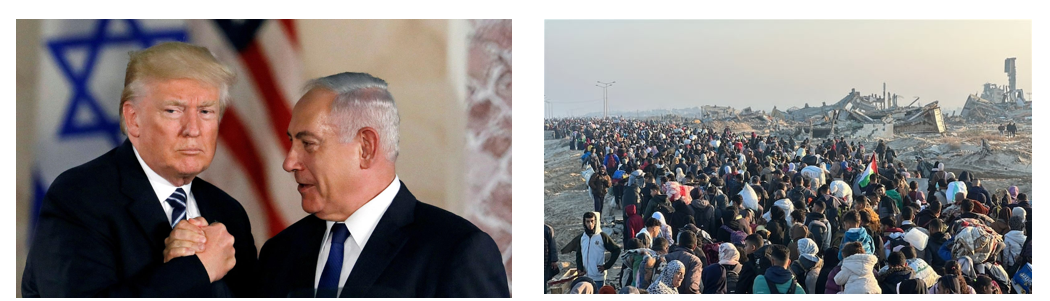
Donald Trump proposed ethnic cleansing of Palestinians who are vigourously resisting by streaming back to northern Gaza and rebuilding. But even in Gaza, they are still refugees. “The real answer is for them to go back to the current state of Israel, from where they were expelled in 1947/48”, says Michael Lynk, former UN Special Rapporteur on Human Rights for Palestinians. Watch our interview.
“Gaza is a disaster area”, said US President Donald Trump. “Its unliveable. The people have to get out”.
Gaza IS a disaster area, of course, but with Prime Minister Netanyahu beside him, Trump made no mention of why it is so and who has done the destruction.
While Trump’s proposal to expel the Palestinians was praised by Israel’s advocates in the USA as “out of the box” thinking, to many observers it seemed like Trump had “jumped into the historic Zionist box” of ethnic cleansing of the Palestinian people.
Most Palestinians in Gaza don’t want to be there at all. In 2018, they demonstrated in their thousands during the “Great March of Return” which was met by murderous Israeli fire, killing over 200 unarmed demonstrators.
Over 80% of those who live in Gaza have been living as refugees in UN camps after their parents or grandparents were ethnically cleansed from today’s Israel in 1947/48. The UN has said, repeatedly, that they have the ‘right’ to return. Israel has consistently refused to comply, often using military force against those who try. .
CTIP spoke to Michael Lynk, former UN Special rapporteur on Human rights in the Occupied Palestinian territories, about the legal basis of the Palestinian right to return.
And Canada’s position??
In the interview, Michael Lynk was not able to clearly define Canada’s policy today on the Palestinian right of return. That is because Canada is deliberately being unclear.
In 1949 Canada originally voted in favour of UN Resolution 194, guaranteeing the Palestinians the right to return to what is now Israel. Voluntary repatriation of all refugees to their homelands has subsequently become a cornerstone of international law, and vigorously supported by Canada.
However, in recent years, Canada’s position on UN Resolution 194 has weakened. In 2010, the Canadian government stated that while it acknowledges the “historical and ongoing” Palestinian refugee issue, the “right of return” must be “negotiated among the parties concerned in the context of a final status peace agreement”. In other words Canada now accepts Israel’s right to permanently block the right of return for Palestinians. It seems a way of speaking out of both sides of the Canadian mouth.
Canada Talks Israel Palestine (CTIP) is the weekly newsletter of Peter Larson, Chair of the Ottawa Forum on Israel/Palestine (OFIP). It aims to promote a serious discussion in Canada about Canada’s response to the complicated and emotional Israel/Palestine issue with a focus on the truth, clear analysis and human rights for all. Readers with different points of view are invited to make comment.
Want to learn more about us? Go to Ottawa Forum on Israel/Palestine.ca
 Canada Talks Israel/Palestine
Thanks to Peter and to Michael Lynk for clarifying these important resoutions about Israel and refugees in international law. Though I’ve been aware of them in the past, I need a review of these facts from time to time.
Many Thanks for this interview with Michael Lynk .Having followed the Palestinian suffering under the apartheid system of oppression and now genocide ,there is a glimmer of light that opens up the awareness of people for our understanding of the issues. Thank you Michael for reminding everyone of the UN resolution 194.So many ,I included,were not aware of this.
Hi Peter. Thanks for this very interesting interview with Michael Lynk. I was not aware that Israel’s representative at the UN in 1949, Abba Eban, said that Israel did not have an issue with resolution 194 and so was admitted as a member state to the United Nations. However, after becoming a member state, Israel changed its position but seems to have suffered no consequences .