
President-elect Donald Trump said that because Greenland and Panama are vital for US security, he would not rule out using military force to take them over. For Canada he would only use “economic pressure”. But do Canada, Greenland and Panama have the “right” to exist? Does any country have such a right? Read more…
In recent years, defenders of human rights for Palestinians frequently find themselves bludgeoned with a seemingly simple question. – “Does Israel have the “right” to exist?”
A “yes” answer can be taken as support for Israel’s massive attacks against Palestinians resisting occupation in the name of defending Israel.
However, a “no” answer can be interpreted as vile antisemitism, ready to support or open the door to the extermination of Israelis.
But it’s a trick question often used to create a “gotcha” moment.
The historical record
Countries like Canada, and Panama and Israel, DO exist. They are members of the UN and are recognized by, and have signed treaties with, many other countries.
But no country has the “right’ to exist forever. Over time, states are created, recreated and disappear.
There were only 51 founding members of the United Nations in 1945. Today it has 193 members.
Rhodesia was created in 1965 as the successor state to the British colony of Southern Rhodesia. In 1980, the State of Rhodesia no longer existed. It was replaced by the State of Zimbabwe which joined the United Nations.
Will Canada still exist in 50 years? I hope so, but who says that Canada will survive Quebec independence, Alberta separatism, or Mr. Trump’s expansionist plans?
Why do countries cease to exist?
The World Population Review lists over 40 historical countries which no longer exist. “While it is often tempting for patriotic people to think of their homeland as permanent and everlasting, it is an undeniable fact that sometimes even countries cease to exist.” says the Review.
Some countries merge (East Germany and West Germany, for example) to form a single country. Other countries split apart—for example, the U.S.S.R., Yugoslavia or Czechoslovakia, which dissolved into smaller countries in the late 1980s and early 1990s. The United States absorbed the fledgeling Republic of Texas in 1845. It also annexed large chunks of Mexico to create the US states of California, new Mexico and Arizona.
What about Israel?
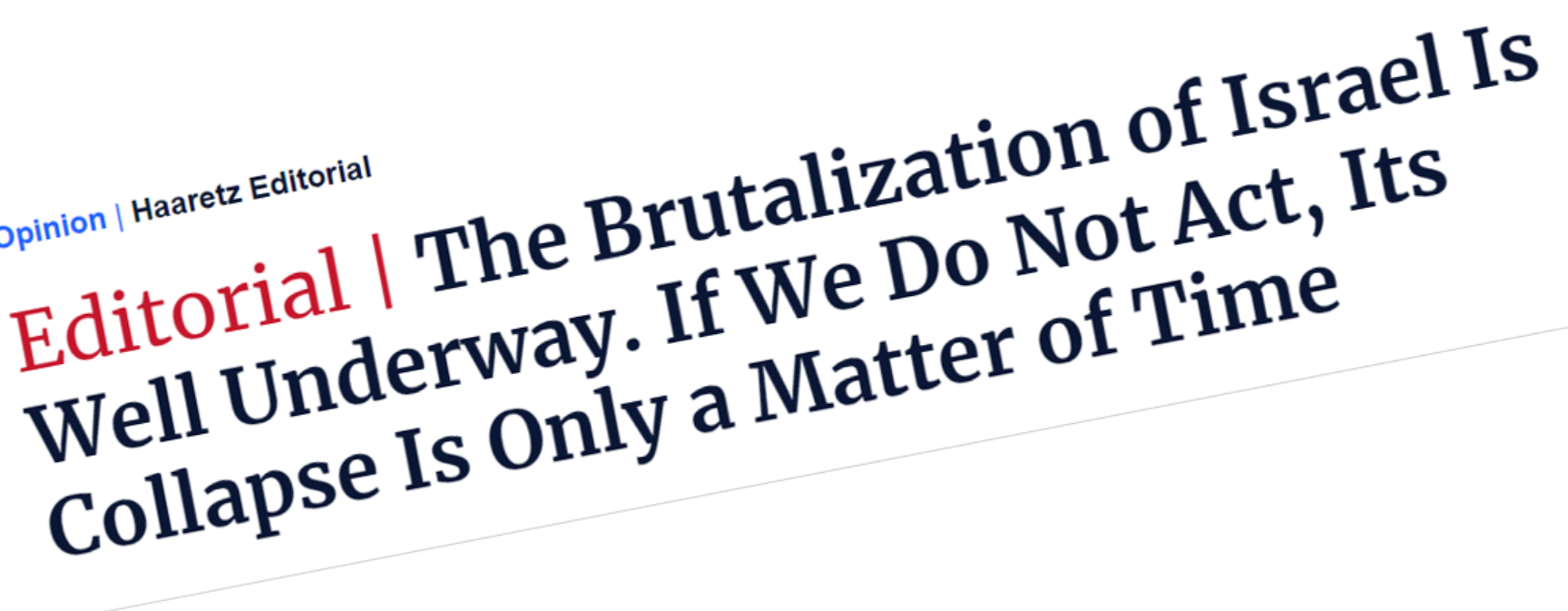
Israel was created in 1948. Will it exist 50 years from now? Maybe. Maybe not. It depends on a lot of factors.
Some Israeli observers now doubt whether the State of Israel will last another decade. They point to Israel’s growing internal tensions and global isolation, as factors challenging its future.
“Israel’s genocidal attack on the Palestinians in Gaza and its expanding take over of Syria, and even south Lebanon, are signs of the last phase of Zionism”, according to Israeli historian Ilan Pappe. “Historically, in ideological movements, (i.e. such as Zionism) whether they are colonials or empires, it’s usually the final chapter [that is] the ruthless one, the most ambitious one. And then it’s too much and then they fall and collapse”.
Will Canada, Panama or Israel exist in 50 years? Nobody knows. No state has the “RIGHT” to exist forever.
Want to know more about the Israel/Palestine issue? Check out OFIP’s special in person introductory course to be held in Ottawa starting February 4th. Its an introductory course meant for those who are curious and find it difficult to understand. More information at: ofip.finance@gmail.com
Canada Talks Israel Palestine (CTIP) is the weekly newsletter of Peter Larson, Chair of the Ottawa Forum on Israel/Palestine (OFIP). It aims to promote a serious discussion in Canada about Canada’s response to the complicated and emotional Israel/Palestine issue with a focus on the truth, clear analysis and human rights for all. Readers with different points of view are invited to make comment.
Want to learn more about us? Go to Ottawa Forum on Israel/Palestine.ca
 Canada Talks Israel/Palestine
Peter – Thanks …well written!
Alex
“The only time it is right to look down at someone is when we are offering our hand to help them get up.” Pope Francis – “Let Us Dream”
>
A country’s right to exist comes from the people that it governs. That right to exist must be recognized if, and only if, a substantial majority of the people in the area claimed want to be governed by the proposed government of that country.
If things change and a substantial number of inhabitants no longer want the country to exist, it has lost its right to exist. If there is a clear “fault line” such that most people on each side of the line are happy for the country to split along that line, then the country should split.
That appears to have been the case in the former Czechoslovakia.
In the former Yugoslavia the borders were not as clear, the split was not peaceful and its stability remains in question. In fact fact, it appears to me that the newly created countries only exist because of external forces.
In the USSR, the internal borders seem to have been clear but each of the new countries had substantial groups that did not like the split.
When there is no clear fault line, there is a need for compromise. For example, the act declaring that Canada had both English and French are official languages with equal status wa a compromise that has helped to keep Canada united. Polls have shown that a large majority of people within Canada want it to exist. That appears to be true for both Panama and Greenland,
In the case of Palestine, I consider the recognition of Israel to have been a mistake. Even at the time of recognition, there was not a substantial majority within the area claimed by Israel (which included land far outside the borders that were recognized) that supported the idea of a state in which Jews had more rights than others. Today, Israel claims effective control of all of the former British mandate of Palestine, the Gaza strip, and parts of Syria and Lebanon. The residents of those areas clearly do not want to be governed by those in power in Israel. Israel never had the right to exist and will not have that right until it makes compromises that allow a substantial majority the people in the land it controls to support its existence.
The State of Israel , I understand, was created by United Nations Resolution 181 in November 1947. I don’t think there are many of the 193 members states that fall into this category, but I do not feel that Israel has more of a right to exist than the other 192 members because of this. Some argue that historic Palestine should become one state, with equal rights and equality for all its citizens. At that point, the State of Israel may cease to exist .
Hi Stephen,
Maybe. But maybe it would still be called “Israel” but with a different set of laws guaranteeing equality.
If the name were to change – the question then becomes “what should happen to the Jews?” Should they all leave? I;m sure most Palestinians wish all of the Jewish colonisers had never come n the first place. (Canadian indigenous people might also wish that you and I had never come to Canada (or our ancestors).
But expellling the Jews from Israel, (including many who were born there and really have no place to go back to) would be trying to solve a current injustice by creating a new one.
That cannot be acceptable. We can’t keep on solving one problem by creating new ones.
Truth and reconciliation is the only answer, IMHO
Hi Peter
Yes truth and reconciliation would be a good path to follow. Those who argue for a one state solution are not suggesting that the Jews leave or be expelled but rather that both Jews and Palestinians live together with equal rights. And yes maybe it would still be called Israel, but most certainly a different kind of Israel than we have today.
Thanks for a great post and discussion that encourages deeper thinking about the phrase “right to exist”. First, do individual persons have a right to exist? Many societies enforce this by making murder a serious crime, often removing the murderer’s right to exist. But some are left out. Through most of history killing a slave, a trespasser or even a wife was not a crime – they apparently did not have a ‘right’ to exist until the last couple of centuries in some states.
How about whole states? Does a state’s right to exist supersede that of a person living in it? What if the state is harmful to its inhabitants and rejected by them?
It seems obvious that the state’s right to exist must derive from its role of looking after its people and land by providing order and justice so they can thrive – all of them. What other legitimate authority can there be? The greedy brute force of a tyrant, or a fascist oligarchy, can’t claim that ‘right’.
I would go further and say that on our small planet, a state cannot claim a right to exist unless it also collaborates with other states in the interests of preserving peace, a livable climate, pollution control and species preservation.