
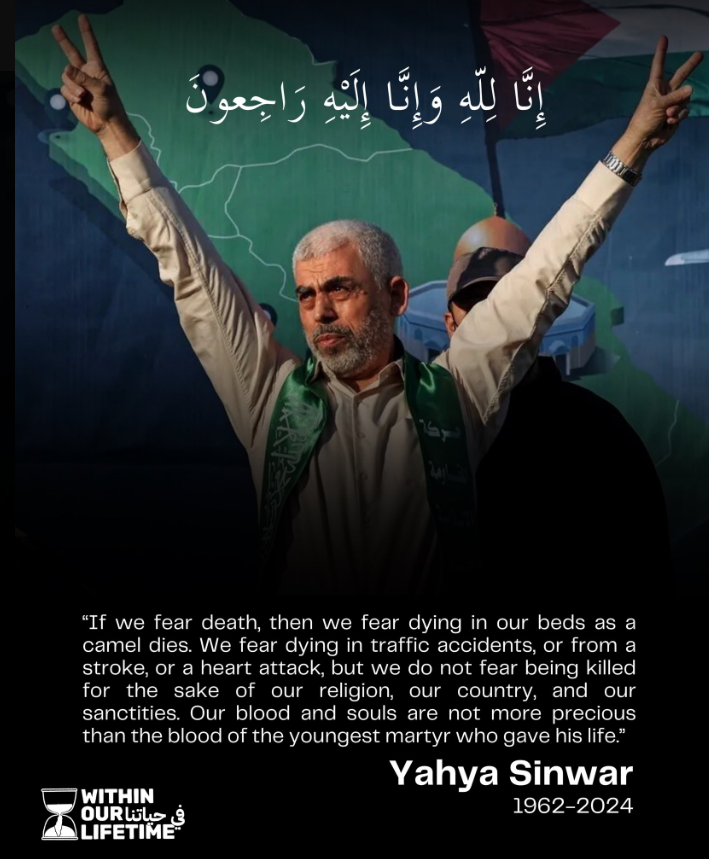
Western leaders from Biden to Trudeau have expressed the hope that the assassination of Yahyeh Sinwar will mean the end of the Palestinian resistance. The historical record doesn’t back that up. Israel’s strategy of “decapitation” of Palestinian resistance movements dates back to its foundation in 1948. While Israel continues to confiscate more and more Palestinian lands and prevent Palestinians from returning, the resistance continues unabated. Read more.
Few Canadians had heard about Sinwar Yahyeh until a few months ago. Canadian media’s portrayal of him is uniformly negative, almost exclusively based on Israeli sources.. “The Hamas leader is ‘a cunning, sophisticated psychopath,’ reported the CBC based on an interview with an Israeli journalist. There is no doubt the Israelis feared Sinwar and saw him as a dangerous resistance leader. He is portrayed as the “architect” of the biggest massacre of Jews since the Holocaust.
That image is largely based on an Israeli claim that the Oct 7th Hamas breakout was principally aimed at killing Israeli citizens. The Hamas explanation of the objective of October 7th – that it was intended to be a military operation aimed at capturing Israeli soldiers to exchange for the thousands of Palestinians in Israeli prison – has not been reported by Canadian media at all.
Who was Sinwar?
Yahyeh Ibrahim Hassan Sinwar[ 29 October 1962 – 16 October 2024) was a Palestinian militant and politician and the leader of the Hamas government in the Gaza Strip from February 2017 until he was assassinated by Israel.
Sinwar was born in the Khan Yunis refugee camp in 1962 to a family who had been expelled from modern Ashkelon in 1948. He studied at the Islamic University of Gaza, where he received a bachelor’s degree in Arabic studies and quickly became involved in activism. In 1989, he was captured by Israeli occupying forces in Gaza, accused of terrorism, convicted after savage interrogation and spent 22 years in prison. During his captivity, he studied history and politics and learned Hebrew. When Hamas negotiated a prisoner exchange with Israel in 2011, Sinwar was at the top of the list of those Hamas wanted to get back.
In 2017, Sinwar was elected as the leader of Hamas in Gaza. He was dedicated to recovering the lands Israel had taken from his family and hundreds of thousands of other Palestinians, by any means necessary. In 2018 he led Hamas participation in a massive peaceful civil disobedience effort known as the “Great March of Return”. It was brutally put down by Israeli snipers who killed over 200 Palestinians and wounded thousands more.
A dangerous step
Palestinian resistance leaders know that as soon as they take on leadership positions, the Israelis are gunning for them. It takes a brave person to take on the job.
According to Israeli researcher Ronan Bergman, Israeli covert agencies have undertaken targeted assassinations against its adversaries throughout its pre- and post-statehood periods. In his book “Rise and Fall”, Bergman claims Israel has assassinated more people than any Western state has since World War II, carrying out “at least” 2,700 assassination operations in the seventy-year period since Israel’s state formation.
Yahyeh Sinwar is only the latest in a list of Palestinian leaders assassinated by Israel from various Palestinian resistance parties. They were killed by a range of Israeli actions in many countries around the world from car bombings, to mafia style executions to poisoning.
NOTE: For a partial list list of assassinated Palestinian resistance leaders over the last 50 years, see the appendix to this article.
Will the assassination of Sinwar end Palestinian resistance?
The assassination of Sinwar was met with joyous glee by Israelis and naive “relief” by many western politicians including Trudeau and Biden. But many Palestinians expressed pride in what Sinwar stood for, what he did and how he died.
“The Palestinian people will continue to resist their oppression, not because one or another leader tells them to, not because they have to be taught to hate oppression but because the desire for liberation is a flame that cannot be extinguished by tanks and bomber jets, by bombs and bullets, by genocide”, said the Palestinian Youth Movement in a statement.
Based on the historical record, it appears unlikely that Sinwar’s death will bring an end to Palestinian resistance. That resistance will only come to an end in one of two ways:
- Either the USA and the western world allow (and even help) Israel to completely exterminate the Palestinians and drive them from their lands (as we did with indigenous people in North America,)
- Or, Israel will be forced to end to the occupation, expulsion and dispossession and allow Palestinians to return to live in peace and equality.
APPENDIX – partial list of Palestinian leaders assassinated by Israeli forces since 1972 (most recent first)
- Yayha Sinwar | October 2024, Gaza strip, Occupied Palestinian Territory
Hamas political leader Ismail Haniyeh was assassinated in Tehran, Iran after the building where he was staying was struck in an attack killing several others.
Ismail Haniyeh | July 2024, Teheran, Iran
Ismail Haniyeh, the political leader of Hamas, was assassinated by Israel along with his personal bodyguard in the Iranian capital Tehran
- Saleh al-Arouri | January 2024, Beirut, Lebanon
Al-Arouri, 57, was the deputy chief of Hamas’s political bureau and one of the founders of the group’s armed wing, the Qassam Brigades. He was assassinated in a drone strike in a suburb of Beirut.
- Mahmoud al-Mabhouh | January 2010, Dubai, UAE
Al-Mabhouh was a military commander in the Qassam Brigades, responsible for logistics and weapons procurement. Al-Mabhouh was assassinated in Dubai. According to police, al-Mabhouh was drugged, electrocuted and then suffocated with a pillow.
- Mahmoud al-Majzoub | May 2006, Sidon, Lebanon
Al-Majzoub was a senior leader of the Palestinian Islamic Jihad group (PIJ) and a close ally of the Lebanese group Hezbollah. He was assassinated in the Lebanese city of Sidon when a car bomb attached to the door of his car door exploded when he opened it.
- Adnan al-Ghul | October 2004, Gaza City, Gaza Strip
Al-Ghul was a high-ranking member of the Qassam Brigades, known as “the Father of the Qassam” for his work in building Hamas’s homemade rocket system. He was assassinated by an Israeli Air Force AH-64 helicopter firing missiles at his car in Gaza.
- Abdel Aziz al-Rantisi | April 2004, Gaza City, Gaza Strip
Al-Rantisi was one of the seven co-founders of the Hamas movement, including Sheikh Ahmed Yassin, in the early days of the first Intifada. He was assassinated by an Israel Hellfire missile from a US made AH-64 Apache helicopter at his car.
- Yasser Arafat 2004
The Israeli government tried for decades to assassinate Arafat, including attempting to intercept and shoot down private aircraft and commercial airliners on which he was believed to be traveling. He died from a mysterious illness in November 2004. Israel claimed he died of AIDS, but forensic specialists point to polonium poisoning.
- Sheikh Ahmed Yassin | March 2004, Gaza City, Gaza Strip
Sheikh Yassin was considered the spiritual leader of Hamas. Yassin, a quadriplegic who was nearly blind, had been reliant on a wheelchair due to a sporting accident when he was 16. He was killed in an Israeli helicopter missile strike as he was being wheeled out of morning prayers outside a Gaza City mosque.
- Salah Shehadeh | July 2002, Gaza City, Gaza Strip
Shehadeh was among the founders of Hamas’s Qassam Brigades and spent a decade in Israeli jails. The Israeli Air Force killed him by bombing his house in Gaza City.
- Yahya Ayyash | January 1996, Beit Lahiya, Gaza Strip
Ayyash, nicknamed “the Engineer”, was known for his work as a bomb maker and commander of the West Bank battalion of the Qassam Brigades. Ayyash was assassinated in Gaza’s Beit Lahiya by Shin Bet operatives who placed an explosive device in his phone, detonating it remotely after he received a call from his father.
- Imad Akel | November 1993, Shujayea, Gaza Strip
Akel was a commander of the Qassam Brigades, In November 1993, Akel had been hiding at his home in Shujayea, which was under siege at the time. After several hours, he tried to escape and was shot by Israeli special forces. He was replaced by Mohammed Deif, one of the architects of October 7th.
- Abu Jihad | April 1988, Tunis, Tunisia
Khalil al-Wazir, known as Abu Jihad, was a key figure in the Palestine Liberation Organization (PLO) – he had helped found Fatah in the late 1950s. For years, he was the effective deputy to PLO Chairman Yasser Arafat. He was shot dead by Israeli agents in an audacious commando raid in 1988.
- Khalid Nazzal | June 1986, Athens, Greece
Nazzal was the central committee secretary of the Democratic Front for the Liberation of Palestine (DFLP) and a leader of the PLO. He was assassinated by Israeli secret agents in Athens.
- Mohamed Boudia | June 1973, Paris, France
Boudia, an Algerian poet and playwright, was a senior member of the Popular Front for the Liberation of Palestine, who had also fought for the liberation of Algeria. He was assassinated by a car bomb placed under the seat of his car by Mossad agents following the attack by the Black September armed group at the 1972 Munich Olympics.
- Abdel Wael Zwaiter | October 1972, Rome, Italy
Zwaiter, a Palestinian translator, was a representative of the PLO in Rome. Israel accused him of being a commander of the Black September armed group that attacked the Israeli team at the 1972 Munich Olympics. His supporters say he was an intellectual with no conclusive links to the group. Zwaiter was shot dead by Israeli agents in the lobby of his apartment building.
- Ghassan Kanafani | July 1972, Beirut, Lebanon
Kanafani, a prominent Palestinian author and poet, was a spokesperson for the Popular Front for the Liberation of Palestine (PFLP). Israeli agents connected a grenade to the ignition switch of his car. Starting the car ignited a plastic bomb killilng Kanafani along with his 17 year old niece.
Canada Talks Israel Palestine (CTIP) is the weekly newsletter of Peter Larson, Chair of the Ottawa Forum on Israel/Palestine (OFIP). It aims to promote a serious discussion in Canada about Canada’s response to the complicated and emotional Israel/Palestine issue with a focus on the truth, clear analysis and human rights for all. Readers with different points of view are invited to make comment.
Want to learn more about us? Go to Ottawa Forum on Israel/Palestine.ca
 Canada Talks Israel/Palestine
Ismail Haniyeh
July 31, 2024, Tehran
thank you. an oversight. now corrected.
Yayeh Sinwar did not create Israel’s century long war of aggression against Palestinians; that war created Sinwah. Had his parents not been expelled from their home, his path in life is likely to have been very different. Israel creates its enemies. When I was born, Jews were known for scholarliness; thanks to Israel’s aggressive policies, we now have a reputation is as very skilled assassins.
Thank you Peter for providing the biographical notes about Sinwar which help us understand how he became the leader he was. How could any journalist referring to him as a psychopathic killer overlook the murderous leadership of Netanyahu and certain members of his cabinet, or the brutal commanders in the IDF.
More murders and assassinations can only mean more truth and reconciliation will be required in the future if real peace and security is ever to be achieved.
In the early morning hours of December 1992, a young IDF cadet who just turned 21 few days prior was patrolling the streets of Sheikh .
He was the last man in the column, groggy and hadn’t had his morning coffee yet.
When all of a sudden he sees another person, about his age who came out of an alley with a squarish Egyptian Carl Gustav SMG and white-blue flip flops.
A burst of three or four rounds was released from the SMG and the flip flop guy disappeared
Turns out the flip flop guy was Imad Aqel, and the next time he met the IDF was about a year later, and ended up exactly as you described it
if you wonder what happened to the IDF cadet, the rounds completely missed him and he went on to be Israel’s leading expert on beaver dam mitigation
Thank you AA for your contribution.
I am not clear on what you are saying or why you are sharing this.
Is it a real story? who is it about? Is Imad Aquel a real person? A Palestinian? From Gaza or elsewhere?
Does ths story have anything to do with the assassination of Sinwar?
Where is Sheikh.? Is that a village in gaza?
I’m not familiar with weapons. What is a Carl Gustav SMG? Are the white-blue flipflops significant? Other than being Israeli colours?
And what does “beaver dam mitigation” have to do with the story? Is that real or metaphorical for someone who was once an IDF soldier but who returned to civilian life after killing “Imad”?