
Amina Elghabawi, Canada’s Special Representative for Combatting Islamophobia, has written a letter to all Canadian University presidents reminding them of their duty to protect free speech. “The right to a “safe space” does not mean that others are not allowed to express views or opinions on issues that someone may disagree with“, she wrote. Read more, including her letter….
Over the summer, a campaign has been building to bring pressure on university administrations to clamp down on protests in favour of rights for Palestinians in the name of making Jewish students on campus feel “safe”.
“Last year many Jewish students and faculty did not feel safe on campus sharing their identity and sharing their support for the State of Israel”, wrote federal antisemitism advisors Anthony Housefather and Deborah Lyons in a joint letter to all Canadian university presidents recently. “Universities have failed to protect their Jewish members”, they argue.
But that view has been challenged by Amina Elghabawi, Canada’s Special Representative on combatting Islamophobia, in her own letter to university administrators.
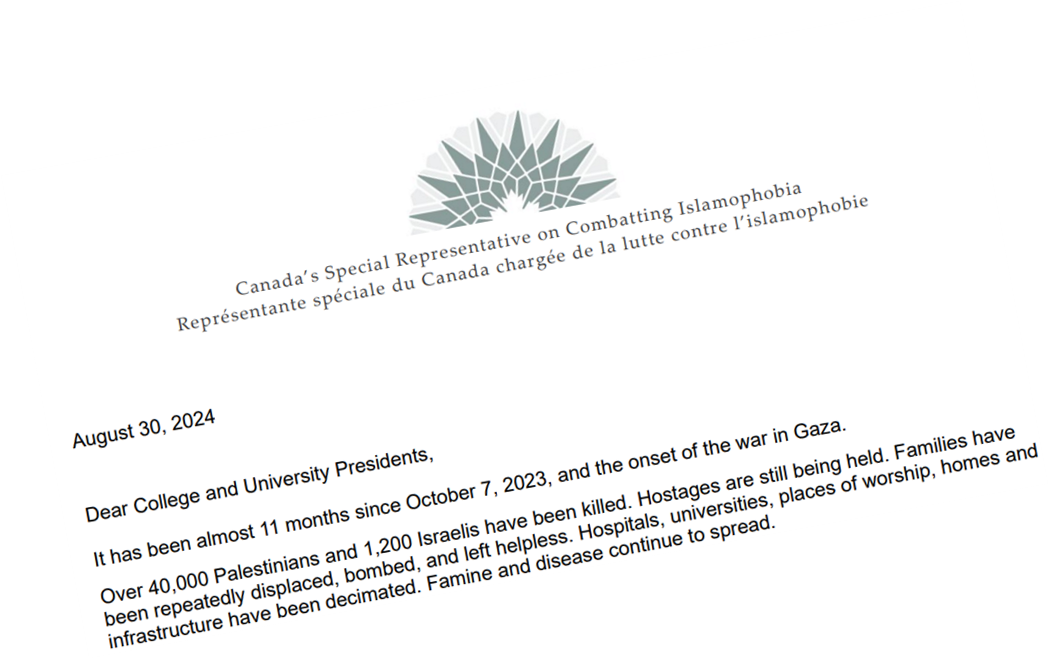
“The right to a “safe space” does not mean that others are not allowed to express views or opinions on issues that someone may disagree with”, wrote Amina Elgabawi, Canada’s Special Representative on combatting Islamophobia, in her own letter to university administrators.
“There is a big difference between feeling “safe” and being “uncomfortable“, she argues.
Far too many (Palestinians and their allies) have faced negative consequences including deliberate silencing, harassment, threats and violence on campuses across the country because of their criticisms of Israel and advocacy for Palestinian rights, she rightly points out.
See the full text of Elgabawi’s letter here.
Being “safe” is not the same as being “comfortable”
Elghabawi is clearly concerned by the attempts of the Zionist lobby to curtail pro-Palestinian activity on Canadian campuses by claiming it makes Zionist Jews ‘uncomfortable’ and actually constitutes a threat to their safety.
Of course, every Canadian should be safe to express their religious identity or political ideas. Freedom of expression is a fundamental principle of a democratic society.
It is legal to be a Zionist in Canada and to defend Israel. (It is also legal to be an anti-Zionist). Students who support Zionism or defend Israel should not be “threatened or intimidated” in any way.
But, students who try to recruit on campus for Hillel Society – a Zionist organization which states a main objective is to defend Israel , for example, should be prepared for some uncomfortable moments and tough questioning. After all, the International Court of Justice has labelled Israel’s actions “plausible genocide’. Defending Israel’s actions in the face of that accusation should make anyone feel “UNCOMFORTABLE“.
Canada Talks Israel Palestine (CTIP) is the weekly newsletter of Peter Larson, Chair of the Ottawa Forum on Israel/Palestine (OFIP). It aims to promote a serious discussion in Canada about Canada’s response to the complicated and emotional Israel/Palestine issue with a focus on the truth, clear analysis and human rights for all. Readers with different points of view are invited to make comment.
Want to learn more about us? Go to Ottawa Forum on Israel/Palestine.ca
 Canada Talks Israel/Palestine
Thanks Peter for an important post. We need to progress to more open debate on campuses and in society broadly.
Universities ought to be bellwether examples for honest debate. Ideologies and religions are beliefs, not truths. Seeking truth is hard work. Defending ethnic ideologies during challenges is usually uncomfortable but it’s the way to understand our biases and become wiser.
Preserving personal respect and dignity must be the bottom line when parties disagree. Ad hominem attacks are out.
Marches and protests will occur when the stakes are high and the politics incendiary or violent, but still, preserving personal respect and dignity among participants and counter-participants must be the fundamental rule. That sets the common ground from which a search for common ground is possible.